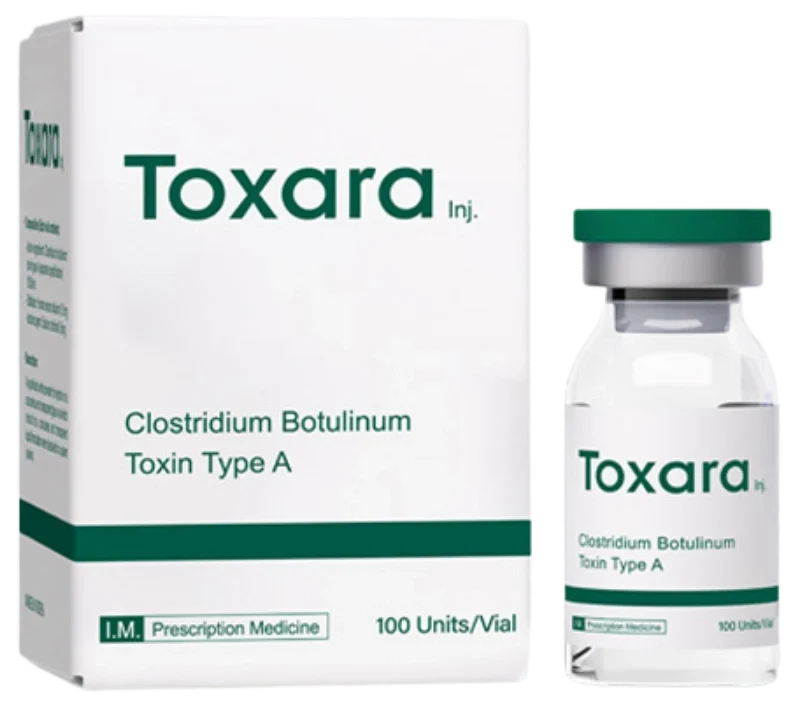
Botulinum toxin injections require precision, especially when working with a high-quality product like Toxara (Clostridium Botulinum Toxin Type A). Whether you are an aesthetic practitioner or a clinical trainee, understanding the correct botulinum toxin reconstitution process and botulinum toxin dosage is critical for patient safety and optimal cosmetic outcomes.
This guide walks you through everything you need to know about botulinum toxin dilution for Toxara, from reconstitution math to indication-specific dosing, plus storage and safety protocols.
What Is Toxara?
Toxara is a lyophilized (freeze-dried) botulinum toxin type A complex. Each vial contains:
-
Active ingredient: Clostridium botulinum toxin type A – 100 Units
-
Stabilizer: Human serum albumin – 0.5 mg
-
Isotonic agent: Sodium chloride – 0.9 mg
The product appears as a white powder in a transparent glass vial. When properly reconstituted with preservative-free 0.9% sodium chloride, it becomes a colorless, transparent liquid free of visible particles.

Why Botulinum Toxin Reconstitution Matters
Botulinum toxin reconstitution is the process of dissolving the lyophilized powder into a liquid solution suitable for injection. This step is deceptively simple but critically important.
Incorrect reconstitution can:
-
Reduce the potency of the toxin
-
Cause inconsistent dosing between injection sites
-
Lead to treatment failure or partial response
-
Increase the risk of antibody formation (secondary non-response)
For Toxara, the gold standard dilution for most aesthetic indications is 100 U per 2.5 mL, yielding 4 U per 0.1 mL. However, depending on the treatment area and patient anatomy, you may choose a more concentrated or diluted preparation.

Toxara Botulinum Toxin Dilution Table
Here is the official dilution guide for Toxara, calculated per 0.1 mL injection volume:
| Added Diluent (0.9% NaCl) | Final Concentration (U/0.1 mL) | Best Used For |
|---|---|---|
| 1.0 mL | 10.0 U | Deep wrinkles, small areas |
| 2.0 mL | 5.0 U | Moderate areas, experienced users |
| 2.5 mL (recommended) | 4.0 U | Glabellar lines (standard) |
| 4.0 mL | 2.5 U | Broader areas, lower doses |
| 8.0 mL | 1.25 U | Microdroplet technique |
Flexible dosing: You can adjust the delivered dose by changing the injection volume without changing the concentration:
-
0.05 mL = 50% dose reduction
-
0.15 mL = 50% dose increase
This flexibility is useful when treating patients with asymmetric muscle strength or when you need fine adjustments around sensitive areas like the lower eyelid or perioral region.
Step-by-Step Botulinum Toxin Reconstitution for Toxara
Follow this protocol every time you reconstitute Toxara:
What You Need
-
Toxara 100U vial
-
Preservative-free 0.9% sodium chloride (sterile saline)
-
1 mL or 2 mL syringe
-
21–23 gauge needle (for diluent transfer)
-
30 gauge needle (for injection)
-
Alcohol swabs
-
Label
Reconstitution Steps
-
Remove from refrigeration – Allow the Toxara vial to reach room temperature (prevents condensation inside the vial).
-
Clean the stopper – Wipe the rubber stopper with an alcohol swab.
-
Draw diluent – Using a sterile syringe, draw the calculated volume of preservative-free saline (e.g., 2.5 mL for standard dilution).
-
Inject slowly – Insert the needle through the stopper and inject the saline slowly against the inner glass wall. Do not inject directly onto the powder to avoid foaming.
-
Gentle mixing – Slightly swirl the vial. Do not shake. Foaming denatures the toxin molecule.
-
Check vacuum – If the vial did not pull the diluent in under negative pressure, discard it. The vacuum ensures product integrity.
-
Inspect solution – The final solution should be clear, colorless, and free of particles. Discard if cloudy or contains visible matter.
-
Label – Write the reconstitution date and time on the vial label. Use within 24 hours.
-
Store properly – Keep the reconstituted solution refrigerated (2–8°C) until use.
Because neither the lyophilized powder nor the diluent contains preservatives, never use one Toxara vial for more than one patient. Doing so risks bacterial contamination and serious injection site infections.
Storage and Handling: Protecting Your Reconstituted Product
Botulinum toxin is a fragile protein. Proper storage preserves its three-dimensional structure and biological activity.
Before Reconstitution (Lyophilized Powder)
-
Store in a refrigerator at 2–8°C.
-
Keep in the original hermetic container.
-
Do not freeze.
-
Protect from light.
After Reconstitution (Diluted Solution)
-
Refrigerate immediately (2–8°C).
-
Use within 24 hours.
-
Do not freeze the reconstituted solution.
-
If not used within 24 hours, discard safely.
Signs Your Product Has Been Compromised
-
Cloudy solution (instead of clear, colorless)
-
Visible floating particles
-
Foam or bubbles that do not settle
-
Missing vacuum upon initial puncture
When in doubt, throw it out. Patient safety always comes first.
Common Mistakes in Botulinum Toxin Dilution
Even experienced injectors can make errors. Here are the most common pitfalls with botulinum toxin dilution and how to avoid them:
| Mistake | Consequence | Solution |
|---|---|---|
| Shaking the vial | Denatured toxin → reduced efficacy | Swirl gently |
| Using preserved saline | Pain, tissue irritation | Use preservative-free 0.9% NaCl |
| Incorrect diluent volume | Wrong concentration → under or overtreatment | Double-check math |
| Using old reconstituted toxin (>24h) | Reduced potency, contamination risk | Always use fresh |
| Storing at room temperature | Accelerated degradation | Keep refrigerated |
| Reusing vial for multiple patients | Infection risk | Single patient per vial |
FAQ
1. Can I freeze the reconstituted Toxara solution?
No. Freezing damages the protein structure. Store only at 2–8°C and use within 24 hours.
2. Why must I use preservative-free saline?
Preservatives (e.g., benzyl alcohol) can cause pain at the injection site and may denature the botulinum toxin molecule.
3. What happens if I inject too much?
Overdose can cause excessive muscle weakness, including spread to adjacent muscles (e.g., ptosis from upper face injections). Treatment is supportive until effect wears off (3–4 months).
4. Can I mix Toxara with lidocaine?
In many practices, mixing with preservative-free lidocaine is common for patient comfort. However, check your local regulations and ensure compatibility. Always reduce the saline volume by the volume of lidocaine added to maintain the correct final concentration.
5. How do I know if my Toxara vial is still good?
Check the vacuum upon first puncture. The solution must be clear. If the powder is clumped, discolored, or the vacuum is absent, discard the vial.
6. Is Toxara interchangeable with other botulinum toxins?
No. Each formulation has different unit potency, molecular size, and diffusion characteristics. Do not use unit-for-unit substitution. Follow Toxara-specific dosing.
Conclusion
Mastering botulinum toxin reconstitution is the foundation of successful aesthetic outcomes with Toxara. Toxara offers reliable potency and consistent results when handled correctly. Respect the reconstitution protocol, respect the storage requirements, and always prioritize patient safety.
Disclaimer: This information is based on the official Toxara prescribing information and is intended for healthcare professionals. Toxara should only be administered by qualified practitioners trained in facial anatomy and injection techniques. Always refer to the complete product information and follow local regulations.