For treating glabellar lines and crow’s feet, mastering the correct botulinum toxin injection points is more important than understanding general wrinkle formation. While these expression lines are caused by repeated muscle activity—such as frowning or squinting—the clinical outcome depends entirely on precise placement.
This guide focuses specifically on the targeted injection points for the corrugator supercilii, procerus, and orbicularis oculi muscles using Toxara botulinum toxin type A to achieve predictable, natural-looking results.
Clinical Considerations Before Injection
Before performing injections, a thorough facial assessment is essential. Practitioners typically evaluate:
- Muscle strength and symmetry
- Degree of wrinkle severity at rest and during expression
- Patient anatomy and eyebrow position
- Previous treatment history
- Desired aesthetic outcome
Standard aseptic technique should always be followed, and precise mapping of injection points should be completed prior to administration. Individual variability plays a significant role in determining both dosage and injection placement. Toxara’s consistent formulation helps minimize product-related variables, allowing practitioners to focus on technique.
Botulinum Toxin Injection Points for Glabellar Lines
The treatment of glabellar lines typically involves targeting three main muscle groups: the procerus, corrugator supercilii, and depressor supercilii.
1. Procerus Muscle Injection Point
The procerus is located at the midline between the eyebrows and contributes to horizontal lines over the nasal bridge. A single injection point is commonly used at the central glabella region. Relaxation of this muscle helps soften the downward pull between the brows.
2. Corrugator Supercilii Injection Points
The corrugator muscles are responsible for vertical “11 lines.” Typically, two injection points are used on each side of the glabella. The first point is placed approximately 1 cm above the orbital rim, ensuring safe distance from the eye. The second point is positioned slightly higher and medially, depending on muscle bulk and patient anatomy.

Care must be taken to avoid diffusion into surrounding muscles to prevent unwanted eyelid or brow effects.
3. Treatment Outcome for Glabellar Lines
After treatment, patients usually begin to notice improvement within 3 to 5 days, with full effects visible at around 10 to 14 days. The result is a smoother, more relaxed glabellar region with reduced frowning activity and improved overall facial expression balance.
Botulinum Toxin Injection Points for Crow’s Feet
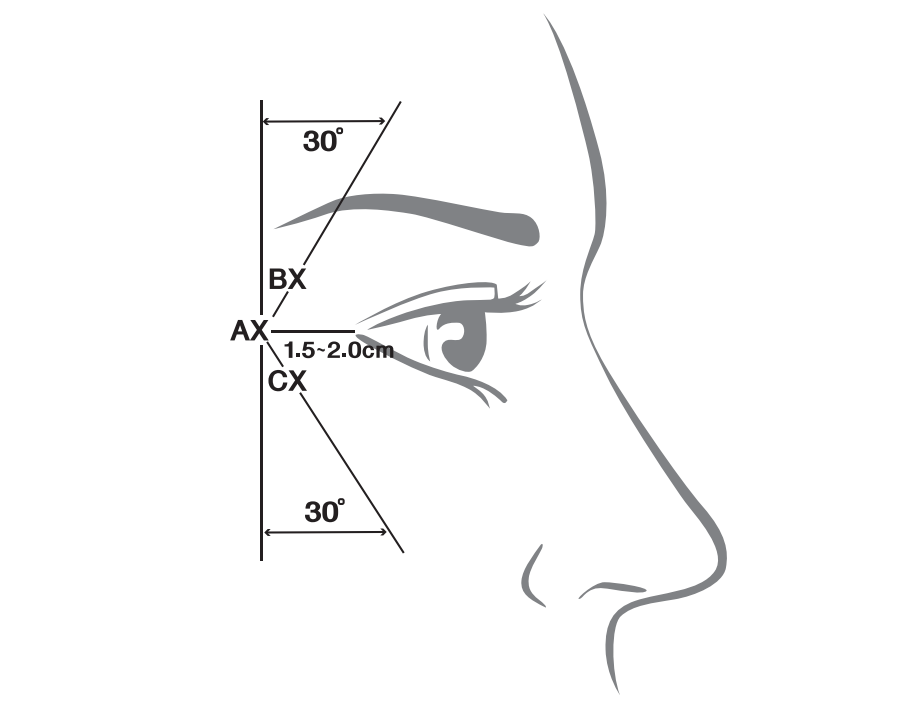
Crow’s feet are treated by targeting the lateral portion of the orbicularis oculi muscle. The injection pattern is typically fan-shaped to match the natural spread of wrinkles.
Injection Technique
Three injection points are commonly used on each side of the eye:
The first point is placed approximately 1 to 1.5 cm lateral to the orbital rim
The second point is positioned slightly above the first, following a 30-degree angle
The third point is placed below the central point to cover the lower lateral fibers
This distribution ensures balanced muscle relaxation while preserving natural eye movement and expression.
Clinical Notes
Injection depth should remain superficial to avoid affecting deeper structures. Over-treatment in this area may lead to a “frozen” or unnatural appearance, so conservative dosing is generally recommended, especially for first-time patients.
While accurate botulinum toxin injection points are essential for achieving predictable outcomes, successful botulinum toxin treatment for crow’s feet also depends on careful patient assessment, appropriate dosing, and proper aftercare. A comprehensive treatment plan helps maximise results while minimising the risk of unwanted complications.
Dosage and Dilution Considerations
Dosage varies based on patient muscle strength and clinical goals. Glabellar lines typically require higher doses than crow’s feet.
For Toxara 100U vials, dilute with 2.5ml preservative-free 0.9% sterile saline to achieve 4U per 0.1ml. Consistent preparation technique ensures reproducible outcomes.
Expected Results and Duration
Visible improvements appear within one week, with full results at two weeks. Effects last 3 to 6 months. Toxara’s preserved bioactivity supports consistent duration across sessions.
Safety and Treatment Balance
Proper anatomy knowledge, careful dosing, and precise placement are essential. Over-injection can cause unwanted effects, while under-treatment leads to incomplete correction. A high-quality product like Toxara provides reliable potency and stability.
Conclusion
Botulinum toxin injection for glabellar lines and crow’s feet remains one of the most effective non-surgical treatments for facial rejuvenation. By targeting specific muscle groups with precise injection points—and choosing a trusted product like Toxara botulinum toxin type A—practitioners can achieve natural-looking, harmonious results that enhance facial expression without compromising individuality.
Understanding injection points, anatomy, and dosing principles is essential for delivering consistent results in clinical aesthetic practice. For a complete walkthrough of the injection process, visit our Practical Guide to Botulinum Toxin Injections.