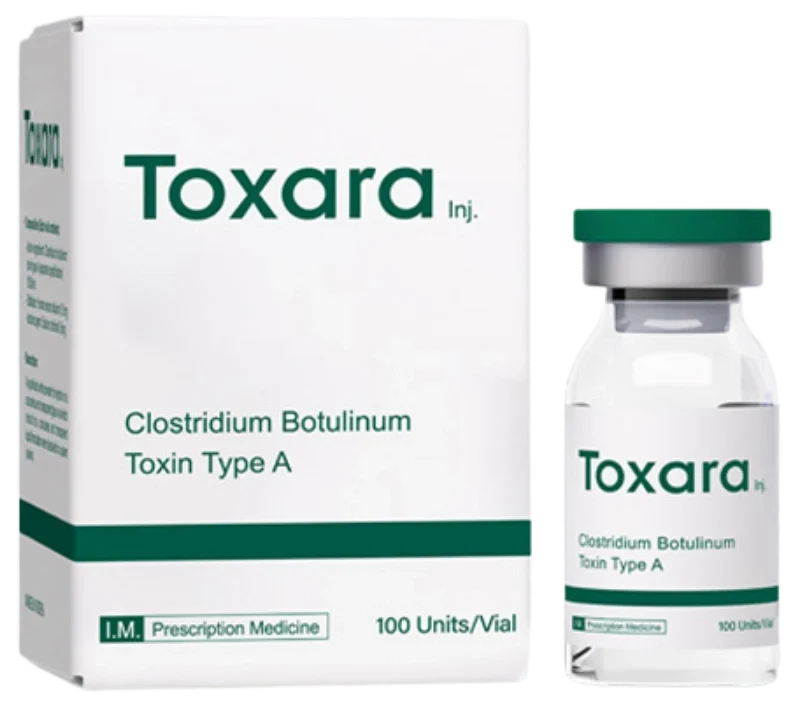
The success of botulinum toxin treatments depends heavily on accurate injection site selection. While botulinum toxin injection areas identify the muscles targeted for aesthetic improvement, injection sites refer to the specific locations where botulinum toxin is administered.
Understanding botulinum toxin type A injection sites allows practitioners to optimize efficacy, improve safety, and reduce the risk of unwanted diffusion.
Part 1. Upper Face Injection Sites

1. Forehead (Frontalis)
Indication: Horizontal dynamic rhytides caused by frontalis overactivity.
Injection Site Mapping:
- 4–6 injection sites distributed across the mid-to-upper frontalis
- Maintain adequate distance from the orbital rim
- Avoid the lower 1–2 cm of the forehead to reduce brow ptosis risk
Typical Dosage:
- Total: 8–20 units
- Per site: 1–3 units
Injection Depth:
- Superficial intramuscular
Clinical Considerations:
- Preserve lower frontalis fibers to maintain brow elevation
- Excessive dosing may produce a flattened forehead appearance
- Individualize site placement according to muscle strength and brow position
2. Glabellar Complex (Corrugator and Procerus)
Indication: Moderate to severe glabellar lines caused by corrugator and procerus activity.
Injection Site Mapping:
Standard 5-point pattern:
- 2 corrugator sites (bilateral)
- 1 procerus site (midline)
- Optional lateral adjustment sites when necessary
Typical Dosage:
- Total: 15–25 units
- Corrugator: 4–6 units per side
- Procerus: 2–6 units
Injection Depth:
- Corrugator: Deep intramuscular
- Procerus: Mid-depth
Clinical Considerations:
- Evaluate maximal frown contraction before marking sites
- Excessive medial placement may increase brow ptosis risk
- Symmetrical site placement is essential
3. Crow’s Feet (Lateral Orbicularis Oculi)
Indication: Lateral dynamic wrinkles during smiling.
Injection Site Mapping:
Three-point fan-shaped pattern per side:
- First site positioned approximately 1 cm lateral to the orbital rim
- Additional sites distributed outward in a fan configuration
Typical Dosage:
- 6–15 units per side
- 2–4 units per site
Injection Depth:
- Superficial intradermal or very superficial intramuscular
Clinical Considerations:
- Avoid medial diffusion toward the zygomaticus muscles
- Conservative initial dosing is recommended
- Site selection should preserve natural smile dynamics
Part 2. Mid-Face Injection Sites
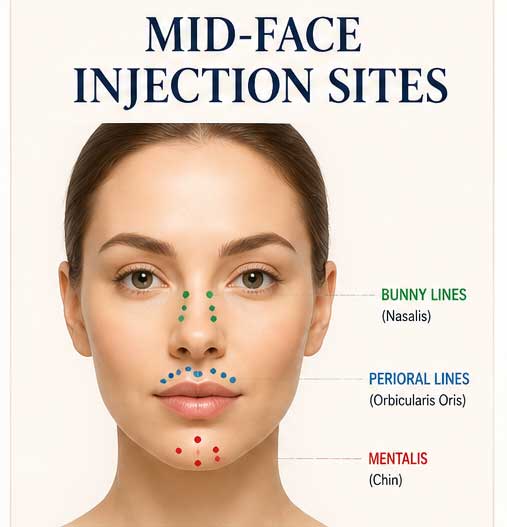
1. Bunny Lines (Nasalis)
Injection Site Mapping:
- 1–2 sites per side along the nasal dorsum
Typical Dosage:
- Total: 2–6 units
Injection Depth:
- Superficial
Clinical Considerations:
- Over-treatment may affect natural nasal expression
- Maintain bilateral symmetry
2. Perioral Lines (Orbicularis Oris)
Injection Site Mapping:
- 4–6 micro-injection sites around the vermilion border
- Avoid excessive midline dosing
Typical Dosage:
- Total: 2–6 units
Injection Depth:
- Very superficial intradermal
Clinical Considerations:
- Preserve speech and oral competence
- Suitable only for experienced injectors
- Conservative dosing is critical
3. Mentalis (Chin)
Injection Site Mapping:
- Two-point pattern for mild dimpling
- Four-point pattern for more severe activity
Typical Dosage:
- 4–10 units total
Injection Depth:
- Mid-to-deep intramuscular
Clinical Considerations:
- Avoid excessive relaxation
- Monitor for lower lip dysfunction
- Assess smile dynamics before treatment
Part 3. Lower Face Injection Sites
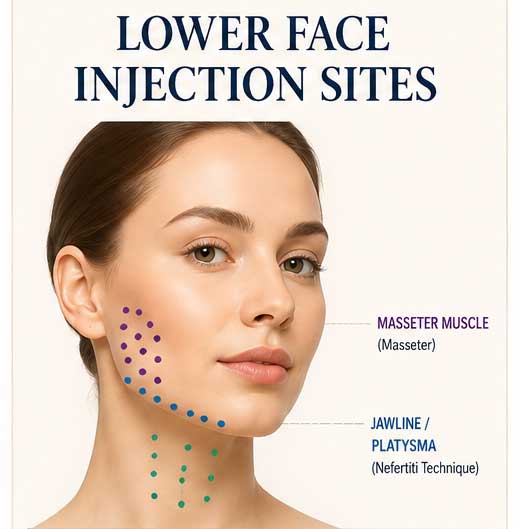
1. Masseter Muscle
Indication: Masseter hypertrophy, bruxism, and lower-face widening.
Injection Site Mapping:
- 3–5 injection sites per side
- Focus on the posterior-inferior masseter belly
- Confirm hypertrophy through palpation during clenching
Typical Dosage:
- Mild hypertrophy: 20–30 units
- Moderate hypertrophy: 30–40 units
- Severe hypertrophy: 40–60 units
Injection Depth:
- Deep intramuscular
Clinical Considerations:
- Avoid superior placement near the zygomatic arch
- Over-treatment may contribute to mid-face hollowing in low-BMI patients
- Reassessment after 4–6 weeks is recommended
2. Jawline and Platysma (Nefertiti Technique)
Injection Site Mapping:
- Linear sites along the mandibular border
- Vertical sites along active platysma bands
Typical Dosage:
- 10–25 units total
Injection Depth:
- Superficial intramuscular or subdermal
Clinical Considerations:
- Avoid deep anterior neck injections
- Maintain bilateral symmetry
- Assess swallowing function and neck anatomy before treatment
Factors Influencing Injection Site Selection
Although standardized patterns provide useful guidance, injection sites should always be adapted to individual anatomy.
Several factors may influence final placement decisions:
- Muscle Strength: Patients with stronger facial musculature often require wider treatment coverage and additional injection sites.
- Gender: Male patients frequently present with larger muscle mass and may require modifications to both injection mapping and dosage.
- Facial Asymmetry: Natural asymmetry is common and should be identified before treatment planning. Injection sites may need adjustment to achieve balanced outcomes.
- Previous Botulinum Toxin Treatments: Prior treatment history can influence muscle activity patterns and affect site selection during subsequent sessions.
Proper injection placement should always follow facial anatomy and muscle function. For more injection principles, see our Botulinum Toxin Injection Technique guide.
Product Considerations for Multi-Site Treatment Protocols
Modern aesthetic treatment plans frequently involve multiple facial regions during a single appointment. In these cases, consistent product performance becomes increasingly important for maintaining predictable outcomes across different injection sites. Factors that may influence treatment consistency include:
- Reconstitution characteristics
- Diffusion profile
- Potency consistency
- Clinical handling properties
Toxara Botulinum Toxin Type A is designed to support standardized treatment protocols across a variety of facial indications. Its consistent handling profile allows practitioners to perform treatments across multiple botulinum toxin type A injection sites while maintaining individualized treatment planning based on patient anatomy and clinical objectives.
For practitioners seeking reproducible results, combining appropriate injection site mapping with consistent product performance can contribute to improved treatment predictability and patient satisfaction.
Conclusion
Successful aesthetic outcomes depend on more than selecting the correct treatment area. Precise botulinum toxin type A injection sites play a critical role in treatment safety, efficacy, and long-term patient satisfaction.
By combining accurate injection site mapping, conservative treatment principles, and reliable botulinum toxin products such as Toxara Botulinum Toxin Type A, practitioners can achieve predictable and natural-looking results across a wide range of aesthetic indications.
Disclaimer: The information provided is for educational and professional reference only and does not constitute medical advice or treatment guidance. All botulinum toxin procedures should be performed by licensed medical professionals following applicable regulations, approved product instructions, and individual clinical assessment.