In clinical aesthetic practice, botulinum toxin injection areas are selected based on functional muscle activity, patient anatomy, and treatment objectives rather than a fixed anatomical map. Treatment outcomes depend on correct indication assessment, dosing strategy, and controlled diffusion within targeted muscle groups.
This document summarizes commonly treated areas to help practitioners develop effective treatment plans while minimizing complications.

Understanding Botulinum Toxin Injection Areas
Botulinum toxin works by temporarily reducing muscle activity. As a result, treatment areas are selected according to the muscles responsible for dynamic facial movement rather than wrinkle location alone.
Several factors influence area selection:
- Muscle strength and activity
- Facial anatomy
- Gender differences
- Age-related changes
- Desired aesthetic outcome
- Previous treatment history
A comprehensive assessment allows practitioners to customize treatment for each patient.
1. Upper Face Injection Areas
Forehead (Frontalis)
The forehead is one of the most frequently treated botulinum toxin injection areas. Horizontal forehead lines develop through repeated contraction of the frontalis muscle.
Treatment aims to soften dynamic wrinkles while preserving natural facial expression. Proper forehead treatment requires careful balance to avoid excessive relaxation that may affect brow position.
Glabellar Complex
The glabellar region, located between the eyebrows, is commonly associated with frown lines. These lines are primarily caused by the corrugator and procerus muscles.
Treating this area can create a more relaxed appearance and reduce the appearance of moderate to severe vertical lines.
Crow’s Feet
Crow’s feet appear at the outer corners of the eyes during smiling and facial expression. These wrinkles result from repeated contraction of the orbicularis oculi muscle.
Treatment in this area can help soften lateral eye wrinkles while maintaining a natural smile.
2. Mid-Face Injection Areas
Bunny Lines
Bunny lines develop on the sides of the nose during facial expression and smiling. Although often subtle, these lines can become more noticeable with age or after repeated upper-face treatments.
Botulinum toxin may be used to reduce excessive nasalis muscle activity and improve overall facial harmony.
Perioral Area
The area surrounding the mouth requires a conservative approach due to its important role in speech, eating, and facial expression.
Carefully selected treatments may help soften fine perioral lines while preserving normal function.
Chin (Mentalis)
Overactivity of the mentalis muscle may produce chin dimpling or an uneven skin texture commonly referred to as a “pebbled chin.”
Targeted treatment can improve chin smoothness and contribute to better lower-face balance.
3. Lower Face Injection Areas
Masseter Muscle
The masseter is one of the most popular lower-face treatment areas. Botulinum toxin can be used to address masseter hypertrophy, teeth grinding, and lower-face widening.
Reduction of excessive masseter activity may create a slimmer facial contour and improve jawline definition.
Jawline and Platysma
Botulinum toxin may also be incorporated into jawline and neck rejuvenation protocols.
Treatment of platysma activity can help improve neck contour and support lower-face lifting strategies, particularly when combined with other aesthetic procedures.
How Practitioners Select Treatment Areas
No two patients require identical treatment plans. Practitioners typically evaluate:
- Facial symmetry
- Muscle dominance
- Dynamic wrinkle patterns
- Skin quality
- Treatment objectives
A personalized approach often produces more natural and predictable results than standardized treatment patterns.
Product Selection and Clinical Consistency
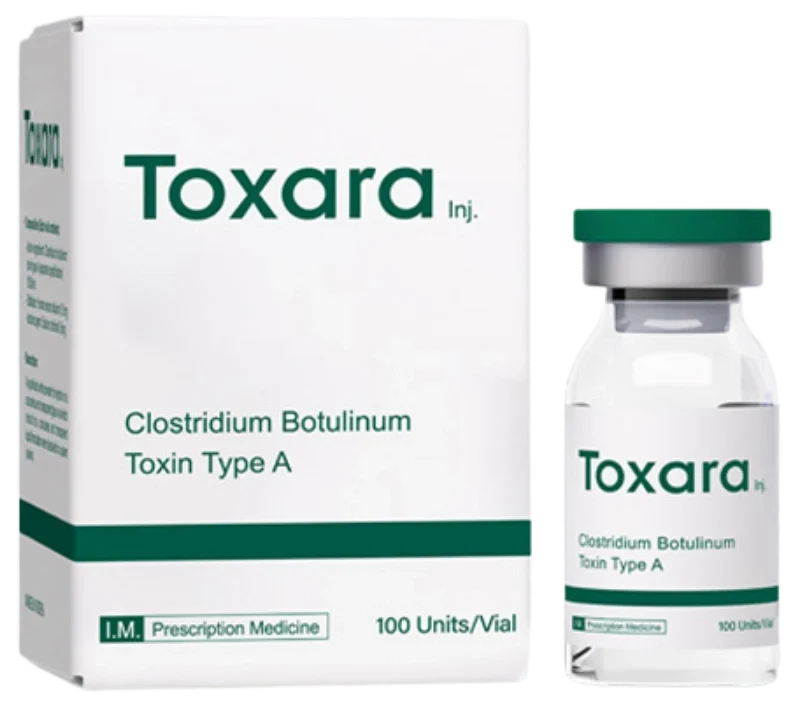
Consistent treatment outcomes depend on both practitioner expertise and product performance. When treating multiple botulinum toxin injection areas during a single session, predictable diffusion characteristics and reliable potency can support more accurate treatment planning. Toxara Botulinum Toxin Type A is designed to support consistent clinical performance across a variety of facial treatment areas, allowing practitioners to develop customized protocols based on individual patient needs.

Conclusion
Understanding common botulinum toxin injection areas is an essential part of aesthetic treatment planning. From the forehead and glabellar complex to the masseter and platysma, each treatment zone presents unique anatomical considerations and clinical objectives. For a more detailed breakdown of anatomical precision and injection mapping, see our article on botulinum toxin type A injection sites.
Forpractitioners seeking predictable and natural-looking outcomes, careful area selection, individualized assessment, and consistent product performance remain the foundation of successful botulinum toxin treatments.