Crow’s feet remain one of the most frequently requested aesthetic treatments worldwide, as patients seek a refreshed appearance while maintaining natural expressiveness. Botulinum toxin for crow’s feet offers a proven, minimally invasive solution for softening lateral canthal lines when administered with precision and anatomical expertise.
This guide provides aesthetic professionals with evidence-based protocols for botulinum toxin crow’s feet treatment, emphasising the importance of product quality, patient assessment, and injection technique to achieve optimal, natural-looking outcomes.
What Causes Crow’s Feet?
Crow’s feet (lateral canthal lines) are dynamic wrinkles caused by repeated contraction of the orbicularis oculi muscle during smiling and squinting. Over time, repetitive muscle movement, combined with aging, UV exposure, and reduced skin elasticity, can make these lines visible even at rest.
How Effective Is Botulinum Toxin for Crow’s Feet?
Botulinum toxin type A is the first-line treatment for dynamic crow’s feet. It temporarily relaxes the orbicularis oculi muscle to reduce expression-induced wrinkles while preserving natural smile function when injected correctly.
Most patients see improvement within 3 to 7 days, with peak results at around 2 weeks. Clinical studies consistently report high patient satisfaction, making it one of the most reliable and widely performed non-surgical periorbital rejuvenation treatments.

Patient Assessment Before Treatment
A proper patient assessment is essential before treating crow’s feet with botulinum toxin. Clinicians should evaluate wrinkle severity, muscle activity, and skin condition to determine suitability for treatment. Patient expectations should also be reviewed to ensure realistic outcomes. In some cases, combination treatments such as fillers or skin resurfacing may be considered.
Injection Planning for Crow’s Feet
1. Target Muscles
The primary target is the lateral orbital portion of the orbicularis oculi muscle, which encircles the eye and controls eyelid closure, smiling, and squinting.
2. Treatment objective
Reduce lateral canthal rhytid severity while preserving natural facial expression and avoiding unintended effects on adjacent muscles.
3. Injection Technique Considerations
Successful treatment of crow’s feet requires a thorough understanding of facial anatomy, careful botulinum toxin injection points, and conservative dosing to achieve natural-looking results.
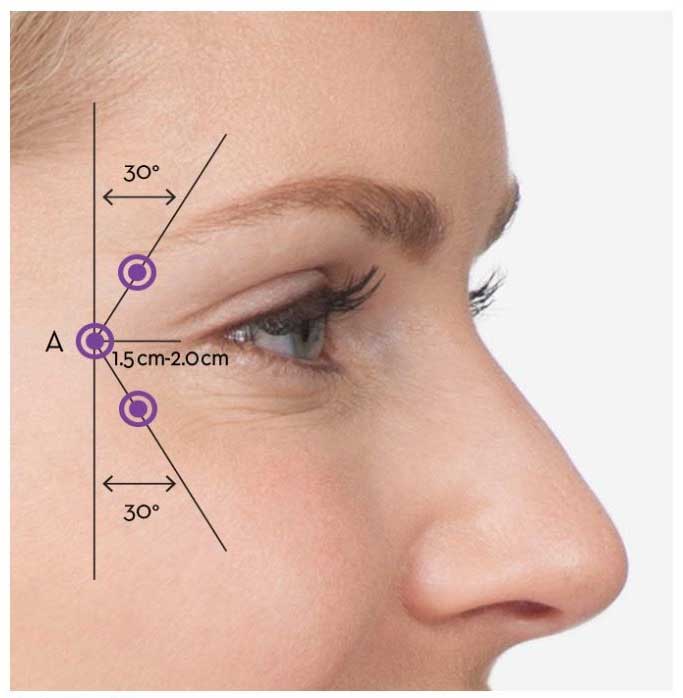
- Injection pattern: Three points per side, approximately 20 mm from the lateral canthus, in superior (30° upward), lateral (horizontal), and inferior (30° downward) directions.
- Dosing: 4 to 6 units per side total, distributed as 1–2 units per point. The inferior point should receive a smaller dose to prevent asymmetrical smiling from zygomaticus diffusion.
- Depth: Subdermal or intradermal, as the orbicularis oculi lies in the superficial SMAS layer.
- Symmetry: Treat both sides symmetrically, adjusting for any pre-existing muscle asymmetry.
- Natural expression: Use conservative dosing and precise placement to soften lines rather than eliminate movement, avoiding a “frozen” appearance.
- Avoiding diffusion: Place injections away from the orbital rim to prevent spread (up to 1.5–3 cm) into extraocular muscles (causing diplopia) or the levator palpebrae superioris (causing ptosis).
Patient Selection
Ideal candidates:
- Mild to moderate dynamic crow’s feet that worsen with expression
- Realistic expectations
- No contraindications to botulinum toxin therapy
Contraindications:
- Significant static wrinkles, hollows, or under-eye bags (may require adjunctive treatments)
- Active infection or inflammation at injection sites
- Neuromuscular disorders (e.g., myasthenia gravis, Eaton-Lambert syndrome)
- Pregnancy or breastfeeding
- Known allergy to botulinum toxin or human albumin
Treatment Frequency
Recommended maintenance intervals: Most patients benefit from repeat treatments every 3 to 4 months to maintain optimal results.
Factors influencing longevity:
- Individual metabolic rate
- Dosage administered
- Muscle mass and activity level
- Prior treatment history (some evidence suggests repeated treatments may lead to longer-lasting effects due to muscle atrophy)
What aftercare instructions should patients follow?
- Avoid rubbing or massaging the treated area for 24 hours
- Remain upright for at least 4 hours post-treatment
- Avoid alcohol and blood-thinning medications for 24 hours to reduce bruising risk
- Schedule follow-up at 2 weeks for assessment and potential touch-up
Safety Considerations and Possible Adverse Effects
Common Temporary Reactions:
- Mild redness, swelling, or bruising at injection sites
- Temporary tenderness or numbness
Potential Complications:
- Ptosis (eyelid droop): Caused by diffusion to the levator palpebrae superioris. Prevented by avoiding injections close to the orbital rim.
- Diplopia (double vision): Rare, resulting from unintended extraocular muscle involvement. Minimised by maintaining distance from the orbital rim.
- Asymmetrical smile: Caused by diffusion into zygomaticus muscles. Prevented by lower dosing at the inferior injection point.
- Ocular surface effects: Possible temporary dry eye symptoms; counsel patients accordingly.
All botulinum toxin treatments should only be performed by qualified professionals with thorough anatomical knowledge.
Choosing a Reliable Botulinum Toxin Product
Product selection significantly influences treatment outcomes. Choosing a product with consistent potency and predictable diffusion characteristics is an important consideration for practitioners.
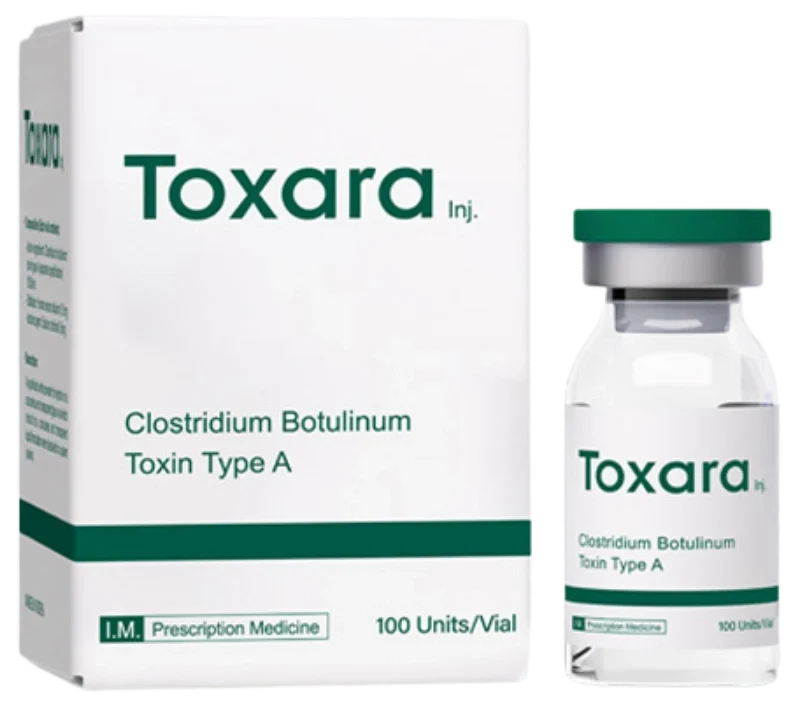
Products such as Toxara Botulinum Toxin Type A are developed to support consistent clinical performance when administered by qualified healthcare professionals. At Toxara, we understand that aesthetic professionals demand excellence in every aspect of their practice. Toxara Botulinum Toxin Type A is manufactured to the highest quality standards, ensuring consistent potency, purity, and predictable clinical outcomes.

FAQ
How long does botulinum toxin last for crow’s feet?
Results typically last 3 to 4 months. Some patients may experience longer duration with repeated treatments; clinical trials have shown improvement maintenance at 6 months in a significant proportion of patients.
Can crow’s feet be treated together with forehead lines?
Yes. Treating crow’s feet alongside forehead and glabellar lines achieves more balanced, harmonious upper-face rejuvenation. Studies confirm this combination approach is safe and effective.
How soon can patients see results?
Initial improvement is usually visible within 3 to 7 days, with peak results at approximately 2 weeks. Some patients report noticeable changes as early as 24 hours.
Can repeated treatments improve long-term wrinkle appearance?
Yes. Regular treatment reduces repetitive muscle activity over time, helping prevent dynamic wrinkles from progressing into static, deeply etched lines.
Conclusion
Botulinum toxin for crow’s feet remains a cornerstone of aesthetic practice, offering patients a safe, effective solution for periorbital rejuvenation. Success depends on thorough patient assessment, precise anatomical knowledge, and meticulous injection technique.
For aesthetic professionals seeking reliability and clinical performance, Toxara Botulinum Toxin Type A offers rigorous manufacturing standards and proven efficacy. Contact our team for product information, clinical support, or ordering assistance.