Botulinum toxin treatments are widely used for facial rejuvenation and wrinkle reduction, offering predictable and natural-looking results when performed correctly. However, in some cases, patients may notice that the results appear uneven, with one side of the face responding differently from the other.
This situation is not uncommon and does not necessarily indicate a treatment failure. In most cases, botulinum toxin uneven results are temporary and related to natural biological variation, injection technique, or the timing of toxin activity.

What Does “Uneven Botulinum Toxin Results” Mean?
Uneven results refer to a situation where the degree of muscle relaxation differs between two sides of the face or between different injection areas.
This may present as:
- One eyebrow lifting higher than the other
- Asymmetry in forehead movement
- Uneven smile or facial expression
- One side responding faster or more strongly than the other
It is important to note that mild asymmetry can occur even in perfectly performed treatments due to natural facial differences.
Why Do Botulinum Toxin Results Appear Uneven?
Several factors can contribute to uneven outcomes after botulinum toxin injections. These factors are usually a combination of anatomy, injection technique, and individual response.
1. Natural Facial Asymmetry
No human face is perfectly symmetrical. Differences in muscle strength, nerve activity, and bone structure are present in almost everyone.
As a result, even when identical doses are injected on both sides, the response may not be exactly the same.
2. Muscle Strength Differences
Some muscles are naturally stronger or more active than others. For example, one side of the forehead may have stronger contraction patterns, requiring slightly different dosing to achieve balance.
If this variation is not fully accounted for during treatment, uneven results may occur.
3. Injection Technique Variations
Small differences in injection depth, placement, or dosage distribution can significantly influence treatment outcomes.
Factors include:
- Slight differences in injection points
- Variation in injection volume between sides
- Needle angle or depth differences
- Number of injection sites per area
Even minor inconsistencies can lead to noticeable asymmetry in muscle relaxation.
4. Dosage Distribution
Botulinum toxin works in a dose-dependent manner. If one side receives slightly more or less product than the other, the results may not appear balanced.
This is particularly important in delicate areas such as:
- Forehead lines
- Glabellar region
- Periorbital area (crow’s feet)
5. Timing Differences in Onset
Botulinum toxin does not act instantly. It typically begins to take effect within 2 to 5 days, with full results appearing after about 10 to 14 days.
During this period, one side of the face may respond slightly faster than the other, creating temporary unevenness that usually resolves on its own.
6. Product and Handling Factors
Although injection technique is the primary determinant of results, product handling such as reconstitution, storage, and injection consistency may also influence clinical outcomes.
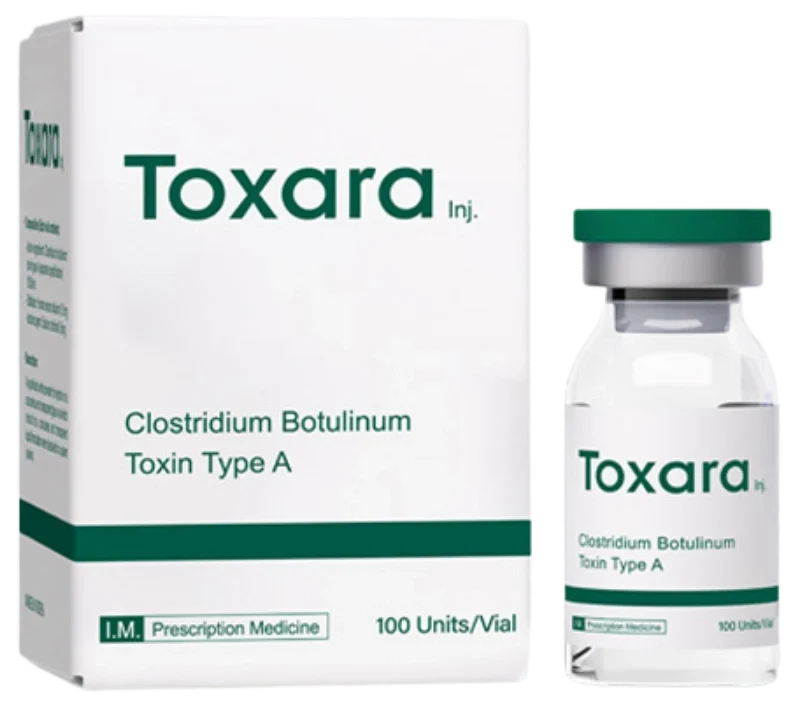
In clinical practice, products with stable formulation and predictable handling characteristics, such as Toxara, help practitioners maintain more consistent results across treatment areas.
Are Uneven Results Permanent?
In most cases, uneven botulinum toxin results are temporary.
As the toxin fully binds to nerve endings and muscle activity stabilizes, asymmetry often improves naturally within 1 to 2 weeks.
If minor imbalance remains after full onset, practitioners may perform a small correction using a follow-up adjustment dose.
How Clinicians Manage Uneven Botulinum Toxin Results?
Experienced practitioners typically use several strategies to reduce or correct asymmetry:
- Careful reassessment after 10–14 days
- Small “touch-up” injections for balance correction
- Adjusting dose distribution in future treatments
- Mapping facial muscle activity before injection
Proper follow-up is an important part of achieving long-term symmetry and patient satisfaction.
Can Uneven Results Be Prevented?
While it is impossible to eliminate asymmetry completely, the risk can be significantly reduced through:
- Accurate facial assessment before treatment
- Balanced dosing on both sides of the face
- Precise injection technique
- Understanding individual muscle strength differences
- Using consistent product handling protocols
Experience and anatomical knowledge remain the most important factors in achieving balanced outcomes.
Conclusion
Uneven botulinum toxin results are usually temporary and often resolve within one to two weeks as the toxin fully takes effect. While minor asymmetries can occur due to natural facial differences or injection technique, they are typically manageable with careful assessment and precise practice. With proper planning and follow-up, practitioners can achieve balanced, natural-looking outcomes.